Strategy
The Three Languages of Strategic HR
Nick Gearen
Jan 20, 2026
I've spent over a decade in HR, and I've watched talented professionals get shut out of strategic conversations they absolutely deserved to be in.
The reason? They spoke fluent HR but struggled with the language of commerce.
Here's what I've learned: Your strategic influence grows when you translate HR concepts into business terms. This isn't about abandoning your people-first values. It's about making those values impossible to ignore in the boardroom.
The Translation Gap That's Costing You Influence
In a 2023 Institute for Corporate Productivity survey, 54% of boards identified human capital as a top issue. You'd think this would be HR's golden moment.
But here's the problem.
70% of CEOs expect their HR leaders to be strategic business partners, but only 55% of CHROs actually meet these standards. That 15-point gap is the credibility gap. It's the difference between having a seat at the table and being asked to leave the room when real decisions get made.
The issue isn't competence. It's communication.
When you talk about engagement scores, executives hear soft metrics. When you discuss retention programs, they hear cost centres. When you present talent pipelines, they wonder about ROI.
You're speaking a language they don't understand, so they tune out.
Why HR Professionals Struggle With Commercial Fluency
The struggle is real, and it's structural.
HRBPs spend almost 19 hours per week handling employee issues and over 16 hours on daily operations. That leaves just nine hours for strategic activities.
You can't become bilingual when you're drowning in transactional work.
I've seen this pattern repeatedly. HR professionals who genuinely understand business strategy get pulled back into operational firefighting. They know they should be in strategic conversations, but the inbox is screaming and someone needs to handle the performance review process and there's an employee relations issue that can't wait.
The operational burden becomes the strategic barrier.
But here's what I've also seen: the HR professionals who break through this cycle don't wait for permission to think strategically. They start practicing commercial translation right where they are.
The Commercial Translation Framework
Let me show you how bilingual leaders actually communicate.
Instead of talking about improved talent acquisition, talk about reducing cost-per-hire by 15% while increasing new hire productivity.
Same initiative, different framing.
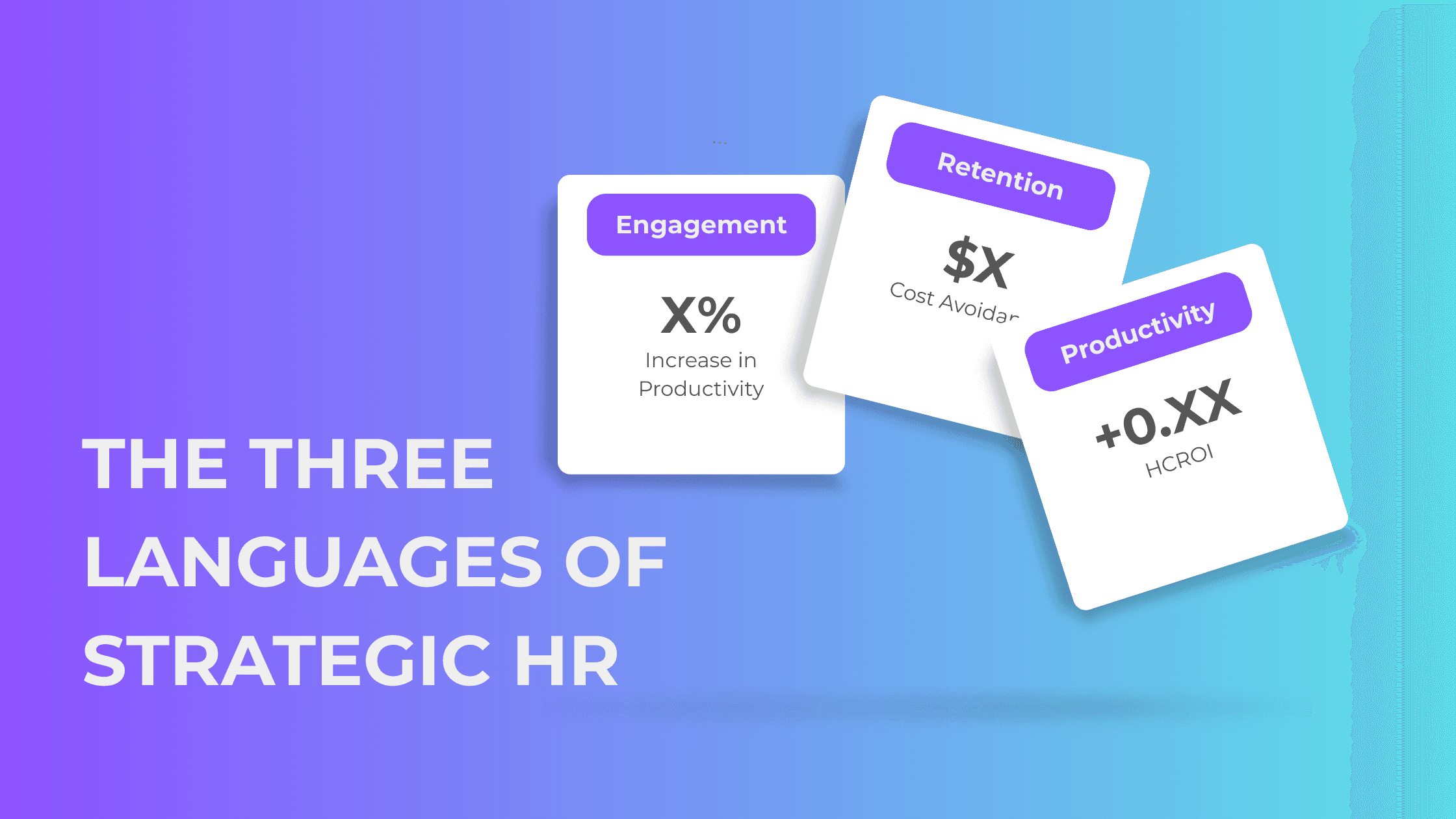
Here's another example. Companies with highly engaged employees achieve 21% higher profitability and 17% higher productivity. That's not a feel-good statistic. That's a direct line from your engagement strategy to the bottom line.
When you present your next engagement initiative, skip the survey scores. Lead with this: "This program is projected to increase productivity by 17%, which translates to $X in additional revenue based on our current headcount."
You just spoke commerce.
The Real Cost of Turnover
Let's talk retention, because this is where HR professionals consistently undersell their impact.
You probably talk about turnover rates and replacement costs. Executives hear: "HR wants more budget for recruiting."
Here's the commercial translation: The cost of losing a single employee can equal 50% to 200% of their annual salary, and burnout-related turnover consumes 15% to 20% of payroll budgets each year.
But go deeper.
Actively disengaged and not engaged employees cost companies $8.8 trillion globally in lost productivity. That's 9% of global GDP.
When you frame retention as cost avoidance at scale, you're no longer running an HR program. You're protecting profit margins and competitive positioning.
The Human Capital ROI Metric
Organisations with a strong use of people analytics experience a 25% rise in business productivity. Data literacy isn't optional for HR anymore. It's the price of admission to strategic conversations.
Here's the metric that changes everything: Human Capital ROI.
If your organisation generates $10 million in revenue, spends $7 million on operating costs, and allocates $2 million to labor, your HCROI is 1.5. Every dollar of labor spend returns $1.50 in value.
This single metric turns people decisions into financial outcomes executives immediately understand.
When you propose a leadership development program, you can now say: "This investment should increase our HCROI from 1.5 to 1.65, generating an additional $300,000 in value from our existing workforce."
You just became bilingual.
Building Your Commercial Vocabulary
Becoming a bilingual leader requires intentional practice.
Start listening differently in business meetings. When executives discuss market expansion, hear workforce capability. When they mention risk mitigation, think succession planning. When they talk about shareholder value, connect it to talent retention.
Every business priority has a human capital dimension. Your job is to make that connection explicit.
Practice reframing your current projects:
Engagement initiative → Productivity enhancement program with projected 17% output increase
Retention strategy → Cost avoidance initiative targeting $X in turnover-related losses
Talent pipeline → Competitive advantage program ensuring critical role coverage and reducing time-to-productivity
Learning and development → Capability investment generating measurable HCROI improvement
Same work. Different language. Completely different reception.
The Market-Oriented HRBP
The future of HR requires greater market understanding and the ability to translate how emerging trends influence your business.
I've watched this shift accelerate. The HRBP role is broadening to include a more market-oriented focus, integrating HR activities with business and market demands.
This means you need to understand your industry's competitive landscape as well as your CHRO does. You need to know what talent your competitors are chasing, what skills are becoming scarce, what workforce trends could disrupt your business model.
You're not just a people function anymore. You're a competitive intelligence function.
When you walk into a strategic planning meeting with insights about talent availability in key markets, competitor hiring patterns, and workforce trends that could create opportunities or threats, you've earned your seat at the table.
Moving From Translator to Strategic Partner
Here's what I want you to understand: becoming bilingual isn't about choosing between people and profits.
It's about recognising that business outcomes and human outcomes are inseparable. Every financial metric has people behind it. Every strategic goal requires human capability to execute.
Your role is to make that connection so clear, so compelling, so quantified that executives can't make strategic decisions without considering the human capital implications.
That's when you stop being the person who implements decisions and become the person who shapes them.
Start this week. Pick one current initiative and practice the commercial translation. Listen for business goals in your next leadership meeting. Calculate the HCROI for your department.
The language of commerce isn't foreign. You just need to practice speaking it.
And when you do, everything changes.
Nick Gearen - Founder SHIFT HR
More to explore
Ready to do some great work together?
Let's catchup, in person or online - we don't mind.